Every Wagon Has a Story. Here's How to Turn It Into Operational Intelligence.
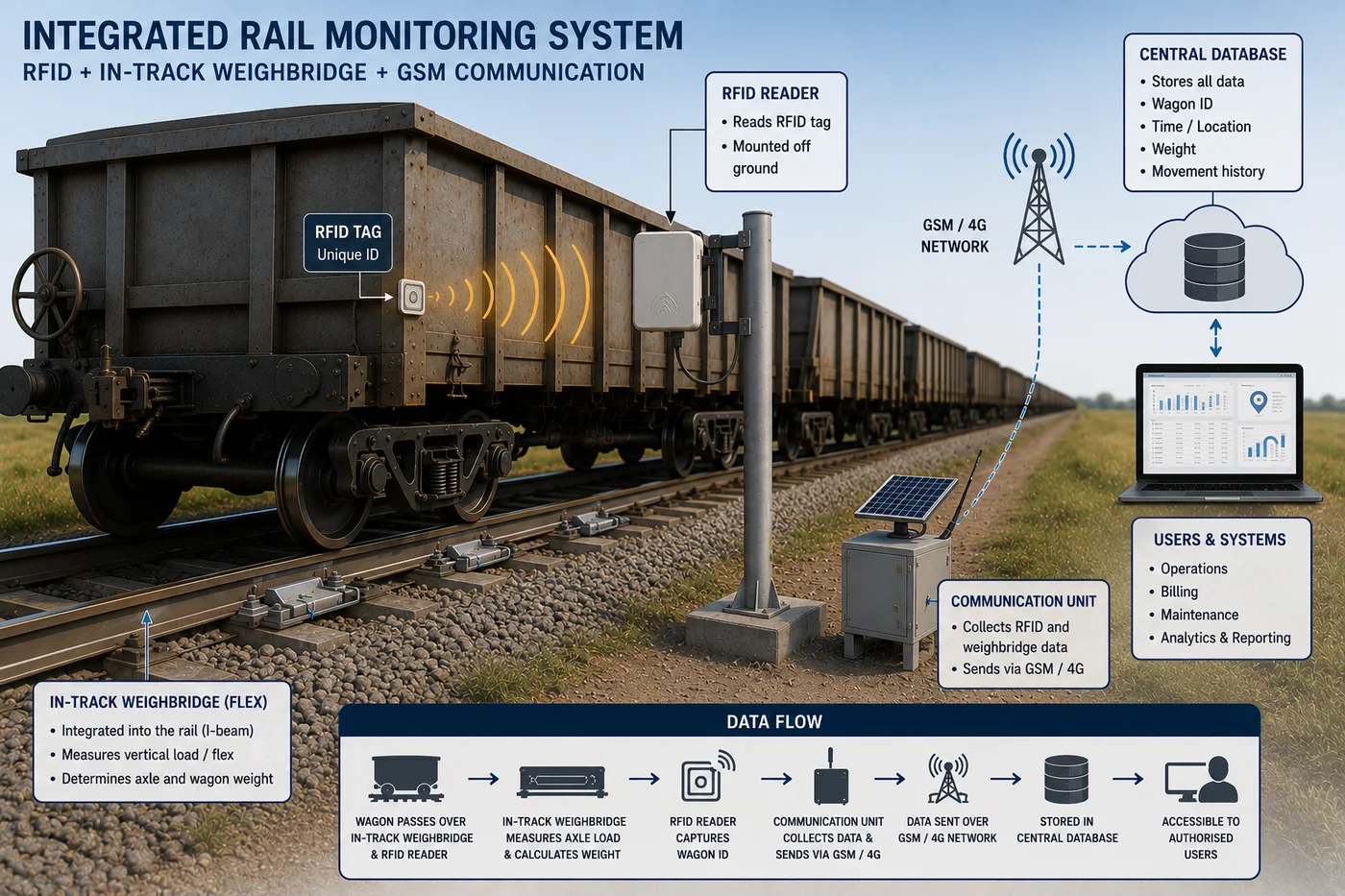
Linking RFID wagon identification with in-motion weighing removes two of the biggest sources of delay and dispute on a rail corridor: stopping to weigh, and reconciling conflicting records afterwards. The payoff isn't just faster trains — it's a growing source of trusted operational intelligence every stakeholder on the corridor can rely on.
This is the thinking behind ECON's C-WIP platform, delivered as Weighing-as-a-Service.
Most rail corridors still struggle to answer two simple questions: which wagon is this, and how much is it carrying? Too often the answer still depends on someone writing it down, or a train stopping long enough to find out. Neither approach scales, and both leave room for disputes that end up costing more than the weighing itself.
RFID identification and in-motion weighbridges solve both problems at once. Linked together, they do something more useful than either does alone: they turn every wagon, on every trip, into a trusted source of operational intelligence — not just a faster weighing process.
How the Two Technologies Work Together
-
1
Identification, without the paperwork
Each wagon carries an RFID tag. Readers positioned along the corridor pick up that identity as the wagon passes — no manual logging, no handoff between shifts, no missing waybill.
-
2
Weighing, without stopping the train
In-motion weighbridges capture axle and gross weight as wagons move through at normal running speed. There's no need to detach a wagon, hold up the line, or route it via a static weighbridge.
-
3
One event, one trusted record
Neither system alone is worth much more than a log. Linked, they produce a single, timestamped record per wagon per trip — identity and weight, captured automatically, the moment it happens.
What Changes on the Corridor
| Traditional Operation | Connected Operation |
|---|---|
| Trains stop to be weighed | Trains keep moving |
| Wagons are identified manually | Wagons are identified automatically |
| Records are reconciled after the fact | One trusted record exists from the start |
| Overloads are discovered later | Overloads are flagged immediately |
| Disputes slow down billing and settlement | Shared data speeds up both |
| Growth adds administrative burden | The system scales with traffic, not headcount |
Why This Matters Beyond the Weighbridge
Southern African rail corridors are rarely run by one party. Network owners, train operators, terminal operators, and shippers each keep their own version of what moved and how much it weighed — often across more than one jurisdiction. When those versions don't match, disputes follow, and reconciliation quietly eats into margins that should be showing up as revenue.
A shared, automatically captured record removes that gap. Every stakeholder works from the same numbers — which is also the kind of operational discipline that funders increasingly expect to see before backing a corridor upgrade: not just a plan, but evidence the corridor already runs on data it can stand behind.
From Data to Operational Intelligence
Every wagon movement generates information. The value isn't in capturing it — it's in what happens once those records accumulate. A corridor that could only ever react to problems after the fact starts to manage its own performance in real time: spotting bottlenecks as they form, rather than in a report weeks later. That shift, more than any single feature, is what separates a weighing system from operational intelligence.
Where ECON Fits
This is the thinking behind C-WIP, ECON's Corridor Weighing Infrastructure Platform, which delivers Weighing-as-a-Service (WaaS): identification, in-motion weighing, and the operational analytics built on that data — as a service, not equipment operators have to buy, install, and maintain themselves.