
WaaS
Weighing-as-a-Service — ECON carries the capital cost; customers pay per ton measured as an operating expense, not a capital project.
The operational intelligence layer behind commodity corridors — in-motion rail weighbridges, RFID wagon identification and live dashboards, built for mining, rail and port operators.
ECON connects measurement infrastructure, asset identity and operational data across commodity corridors — creating trusted information for better operational and commercial decisions.
WaaS — Weighing-as-a-Service. Customers pay per ton measured.
Trusted by industries moving Africa's critical commodities.
Mining · Rail · Logistics · Ports · Commodity Trading

Every corridor begins with infrastructure.
Every opportunity begins with visibility.
A mine dispatches one quantity. A rail operator records another. A terminal receives another. The commercial settlement depends on deciding which number is right.
C-WIP integrates in-track weighbridge, RFID asset identification and GSM/4G communications directly into the corridor — capturing verified weight and identity at the point where the commodity moves, and connecting it into ECON's operational data environment.
Weighing infrastructure captures verified tonnage as the commodity moves through the corridor.
RFID identification associates the measurement with the wagon, vehicle or asset that carried it.
Communications infrastructure sends weight and identity data to ECON's operational data environment.
Movement, weight and identity records are compared across handover points.
Operations, commercial and analytics teams access trusted data through dashboards and reports.
ECON funds, deploys, operates and maintains critical corridor measurement infrastructure as a service — giving customers access to verified operational data without owning the underlying infrastructure.
Weighing-as-a-Service — ECON carries the capital cost; customers pay per ton measured as an operating expense, not a capital project.
Once movement is measured, identified and connected, ECON turns it into intelligence operators and commercial teams can act on.
RFID tags and readers, fitted by ECON to the customer's wagons and vehicles — giving every asset a trusted digital identity.
Dashboards and reporting that turn corridor activity into decision-ready intelligence — throughput, exceptions and reconciliation status, visible in one place.
What changes once infrastructure, data, and decisions are connected.
Know what physically moved.
Know what carried it.
Know where movement slows.
Connect records across handover points.
Turn trusted movement data into better decisions.
Deploy infrastructure without conventional ownership.
Different roles. One connected movement. The same verified record serves every participant in the corridor — even though each is solving a different problem.
Know exactly what leaves the operation.
Know exactly what moved.
Know exactly what arrived.
Connect physical movement to commercial control.
Independent evidence of physical movement.
Every commodity corridor is a chain of handovers — origin, loading, transport, terminal, port, customer. Value is won or lost at each interface. ECON connects measurement, identity and data across those handovers, wherever they sit in the corridor.
Commodity enters the corridor.
Quantity is captured at the source.
The movement itself, tracked in transit.
Custody changes — the point most exposed to disagreement.
Receipt is measured and reconciled.
The verified record supports settlement.
ECON is designed around the realities of physical commodity operations — where infrastructure, assets, people and data have to work together under real operating conditions.
C-WIP brings measurement, identification and communications infrastructure into the movement itself, creating trusted operational data at the point where physical activity takes place.
Measurement happens in the operation. C-WIP integrates weighing infrastructure into critical points in the commodity movement, allowing physical quantity to be captured as part of the operational process.
Weighing · Infrastructure · Automation
The measurement is connected to what moved. RFID and asset identification associate operational data with the physical wagon, vehicle or identified asset involved in the movement.
RFID · Identity · Movement
Operational data does not remain at the measurement point. Communications infrastructure connects field measurement and identification data to ECON's operational data environment.
Capture · Connect · Transmit
The record becomes useful beyond the infrastructure. Connected data supports reconciliation, reporting, analytics and operational visibility — extending the value of the infrastructure beyond the measurement itself.
Reconcile · Analyse · Report
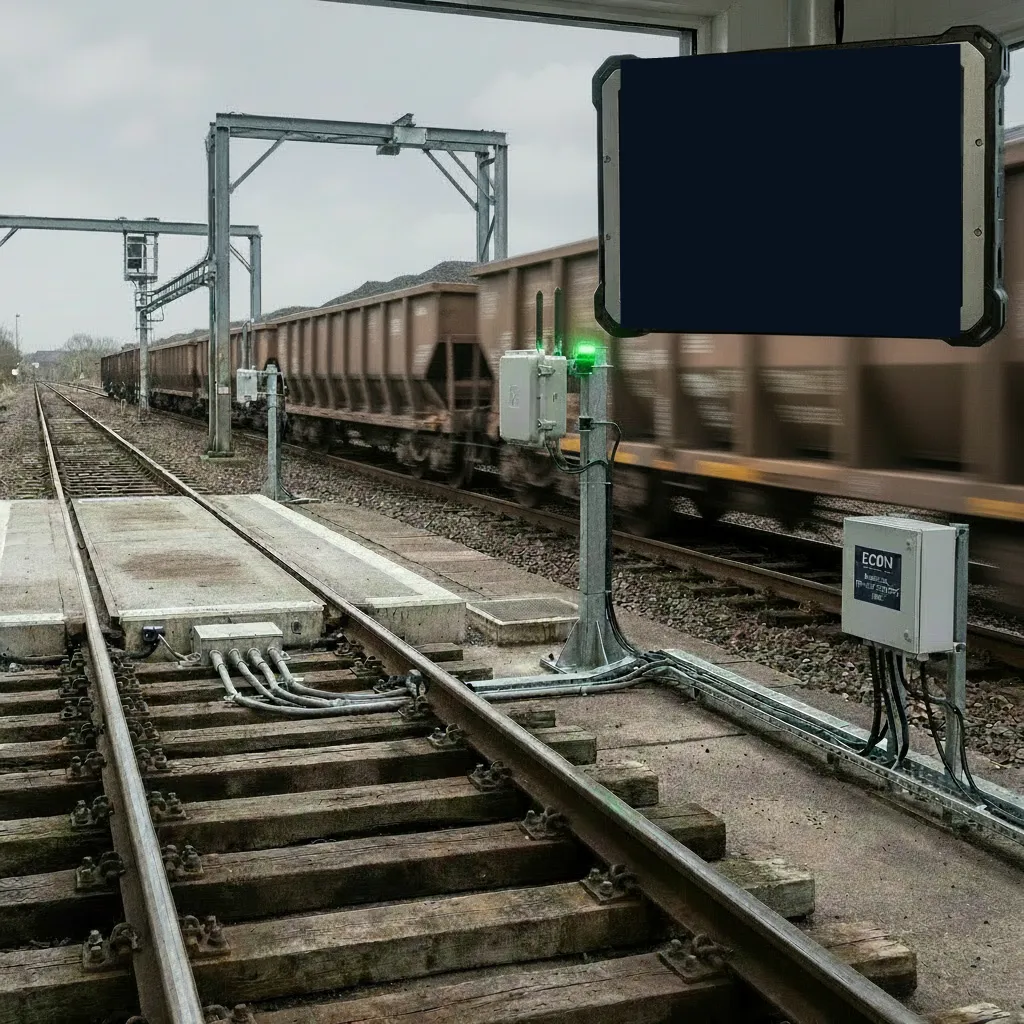
Illustrative concept — how C-WIP connects physical infrastructure to trusted data. Not a photograph of an existing deployment.
C-WIP is not a dashboard looking down on the operation.
It begins with the physical movement — and builds the trusted data layer upward from there.
ECON designs and enables the intelligence layer that connects physical infrastructure, trusted data and operational decisions across commodity movements.
Our approach starts with the operation itself — understanding where commodities move, where infrastructure and information disconnect, and where better measurement and visibility can create meaningful value.
Technology is not the outcome. It is the means to create stronger operational evidence, clearer visibility and better-informed decisions.
We start where the physical movement happens. ECON works from the operational environment outward — connecting measurement infrastructure, asset identity and communications to the movement itself.
Trusted information has greater value when it can stand between systems and participants. ECON's connected layer is designed to create a consistent operational record across critical points in the movement, rather than relying on any one participant's isolated view.
Technology has to create measurable value. Every infrastructure, data and intelligence layer should ultimately support a better operational or commercial outcome.
Designed for the people running the operation — not just the systems behind it. ECON turns complex infrastructure and operational data into information that can be understood and used by the people responsible for movement, performance and commercial decisions.
A Unit of Value. For ECON, value is not created by adding more technology. It is created when infrastructure, trusted data and operational intelligence come together to make the movement more visible, measurable and useful.
The first step is not choosing technology. It is understanding where physical movement, infrastructure and operational records stop connecting. Talking it through with ECON means looking at the critical points in your commodity movement to identify where better measurement, connectivity and operational intelligence could create value.
Where is quantity currently captured — and where are the gaps?
How does the commodity move from origin through transport and handover points?
Can measured movements be reliably associated with the assets carrying them?
Which infrastructure and operational systems are connected — and which remain isolated?
Where do physical movement and operational or commercial records stop agreeing?
Where could connected infrastructure and trusted data improve visibility, control or decision-making?
Start With the Corridor. Then Build What It Needs.
The outcome may be a single critical measurement point, a C-WIP deployment, greater asset visibility, a connected data layer — or a broader corridor infrastructure opportunity. ECON starts with the operational problem and builds from there.
Prefer a direct conversation? Email ECON · Call +27 82 444 5301
ECON — A Unit of Value.
Infrastructure. Trusted Data. Operational Intelligence.